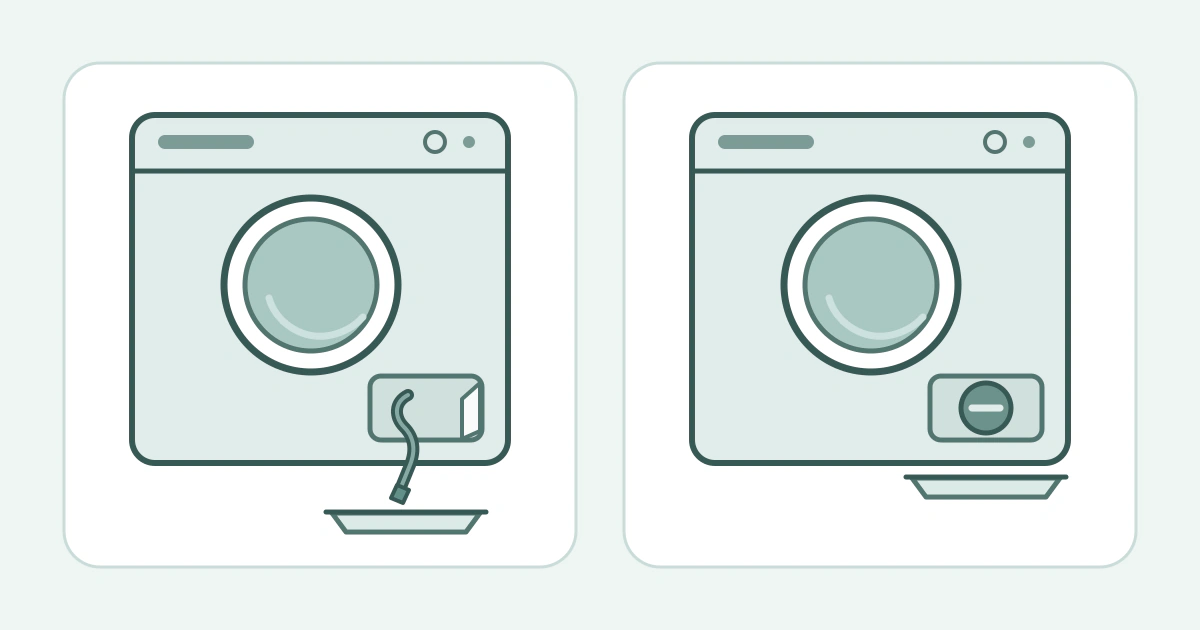
Direct answer
Can you remove the drain pump filter cap while there’s still water in a front-load washer?
If you can see water in the drum, don’t treat the drain pump filter cap like any other cap. Removing it completely could let the water left in the drum rush out. Find the washer’s full model number and look for “Emergency drain” or “Drain pump filter” in the manual. Some models have a small drain hose behind the access panel; on others, the manual directs you to drain through the filter cap. Some models do not have a filter that the user can remove. Being able to open the access panel does not mean everything behind it is removable.
Turn the washer off before you start and unplug it if you can do so safely. If water has pooled near the plug and you cannot safely disconnect the power, do not continue. After a hot wash, wait for the water in the drum to cool. Have a shallow tray and an absorbent cloth ready. If you cannot safely catch the water that may flow out, do not try to open the filter cap. The amount left in the machine depends on what was happening when it stopped; do not assume another person’s drain volume or waiting time applies to yours.
If the manual says to use the emergency drain hose, put the end of the hose over a shallow tray and remove the plug as instructed. On the applicable Haier and Whirlpool models, the hose is used to drain the water before the pump filter is removed. Once the water has drained, refit the plug and clip the hose back into place. A little water may still come out when you remove the filter, so use a shallow tray or cloth to catch it. If nothing comes out of the hose but you can still see water through the door, do not assume the drum is empty or remove the filter cap straight away.
Some manuals use the filter cap itself as the drain outlet. In the examples from Miele and Electrolux, place a shallow tray under the cap and loosen the cap slowly without taking it off. When the tray is nearly full, tighten the cap again to stop the flow, empty the tray, and continue. Once the flow stops, follow the manual to remove the filter completely. Use this method only when your washer’s manual explicitly allows it. Do not copy the turning direction, number of turns or access location from another model.
If you find lint, buttons or coins in the filter, remove them as directed by the manual. Rinse the filter only if the manual allows it. When reassembling, make sure the filter and its cap are correctly seated. If your model has a drain hose, check that its plug is firmly in place. Bosch’s troubleshooting instructions also call for checking for leaks after reassembly. If the washer leaks, the cap cannot be reseated properly, or the drain still does not work, stop using it and contact the manufacturer’s service team instead of repeatedly opening the cap.
Water in the drum does not necessarily mean a blocked filter. Samsung and Bosch also list kinks in the external drain hose as a separate check. Look for kinks or damage along the part of the hose you can see; do not disconnect it or dismantle the washer to investigate. Do not add cleaner, vinegar or drain unblocker to the drum to try to make it drain. Once the washer drains normally again and the drum is empty, you can return to routine drum care. If you use Yipinjing 358 g Washing Machine Cleaner, follow the manual and the package instructions; pump filter maintenance is a separate task.