Direct answer
Uneven or weak shower spray: should you soak the showerhead in vinegar?
Do not soak it in vinegar merely because the spray has become uneven or weak. Follow the model instructions to check spray holes and any user-serviceable filter for deposits or debris, then choose a manufacturer-approved cleaning method. Brands differ on vinegar, citric acid and tools. A remover suitable for an outer surface is not automatically suitable for the whole showerhead or internal seals. Clean, rinse and reassemble as instructed, then check the spray and connections.
First identify the pattern: are only a few jets misdirected, or has the whole showerhead’s flow decreased? Delta notes that reduced or unusual spray may be associated with debris in an aerator or showerhead filter. hansgrohe also notes that deposits in spray holes can affect the pattern. These observations help locate the inspection point; a change in flow alone does not prove limescale is the cause.
For models with the relevant easy-clean flexible nozzles, start with the gentle method permitted by the manufacturer. Delta’s Touch-Clean and hansgrohe’s QuickClean guidance both describe removing deposits from spray holes. Check your model first; similarly named technologies, tools or wiping methods are not features shared by every showerhead.
If a filter needs checking, read whether user removal is permitted and how the gasket and filter are positioned. Delta warns that these small parts may remain inside the connecting nut or stick to the shower-arm end. Protect the bath or floor and drain before removal to avoid losing parts. Ask the manufacturer or installer first if the construction is unfamiliar.
Vinegar soaking is not a universal answer. Delta describes a vinegar-and-water method, but hansgrohe expressly excludes cleaners containing acetic acid and calls for gentle products as instructed. GROHE’s fitting-care guidance also advises against household vinegar and general acidic descalers. A ratio and soaking time for one showerhead should not be transferred to another brand, finish or unknown material.
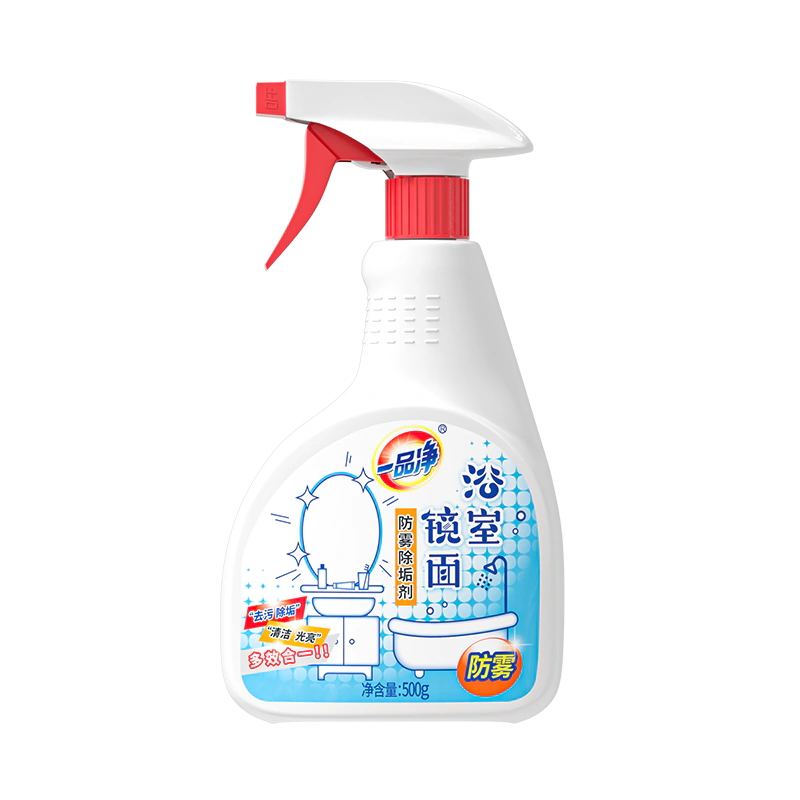
The cleaning object also matters when using Yipinjing 500g bathroom mirror anti-fog and limescale remover. Its label includes light limescale on bathroom tiles, glass and plastic showerhead surfaces. This does not mean that every metal finish, internal passage, seal or complete assembly can use the same soaking method. Check both the purchased package and the showerhead care instructions before deciding where and how to apply it.
The label calls for an inconspicuous test on surfaces that are not acid-resistant, followed by normal use only if no damage occurs. If the showerhead manufacturer already disallows a product or method, a spot test does not replace that requirement. For models requiring cleaner to be sprayed onto a soft cloth first, follow that application method rather than borrowing direct-spray steps from another product. Never mix cleaners.
After cleaning, rinse thoroughly as directed and return user-removable parts to their correct positions. Delta calls for the gasket and filter to be in place, avoiding overtightening and checking the connection for leaks under running water. hansgrohe also calls for rinsing inside and out and checking each spray mode. Tools, sealing tape and tightening methods can vary between connections; do not add assembly steps from another model.
If the permitted treatment does not resolve the spray problem, or a damaged connector or persistent leak is found, stop repeatedly adding cleaner or extending soaking. Contact the manufacturer or a qualified repairer for further checks. Routine cleaning, rinsing and drying as instructed can help limit surface deposits, but cleaning is not a universal repair for every flow fault.